Just Posted: Stories from New Caledonia
August 22, 2002-On Tuesday, Ouvea
wingssail image-fredrick roswold Loyalty Islands Loyalty IslandsOn Tuesday the Easterlies we enjoyed when we first arrived in the Loyalties at Mare Island had turned to North easterlies, and the anchorage was gradually becoming unpleasant, if not untenable. Our next passage would be an overnighter, and at dusk, we weighed anchor and sailed out of the bay, bound for Lifou or Ouvea, depending on what we found in the wind when we got closer to one or the other of these two islands. The wind died however as soon as we left and we wound up motoring through the night, with the main still hoisted, in the seas left from the previous winds, hopeful that the wind would return. Wings wallowed and pitched, flogging the mainsail but there was little that could be done about it short of dropping it all together which meant waking Judy, so we let it go. Ulu, with Mick, Chris, and Tahi aboard, were motoring just ahead of us. Funny how comforting their small white stern light was on the horizon, Ulu, leading the way. All night and into the dawn we motored but 0600 the SE breeze filled in. The sun rose into a clear blue sky and the ocean was changed from a featureless gray to that wonderful deep blue that makes days at sea into religious experiences; it was a gorgeous morning that we knew would be a perfect sailing day. Setting the jib and turning off the motor, we decided that the South easterlies represented the new wind, and would hold true, so the anchorages at Ouvea, which favored winds from this direction, would do nicely. We set our course for Ouvea, another 45 miles further on in the same direction as we had been traveling. Ulu, turning away for Lifou, noticed our diverging course, and called on the radio. "Wings, it looks like you are headed for Ouvea?" They knew we'd left Mare undecided about our destination, while they were firmly in the Lifou camp. We answered in the affirmative and told them we would see them there if they followed along in a few days. We also made plans to continue our daily radio sked. Even though we thought we'd see them again in a few days, we weren't sure, either of us, and this was a bit of a sad parting, two ships sailing off in different directions. Since Sydney we'd been in company with Ulu, not always but frequently, and we usually knew which port we'd both be in next. And we'd grown close to Mick, the bubbly Yorkshire man and Chris, sensitive and artistic, and Tahi, the precocious baby of the sea, conceived in French Polynesia and born in Australia, who couldn't walk yet, but could easily climb the companionway ladders of either yacht and could keep a solid footing against the roll of a sailboat already at one year. She could also say "Judy", which was enough to put her deep into Judy's heart. No, this parting was different. We knew we would be hurrying back to Noumea to check out of the country for Vanuatu while they were going to stay longer in New Caledonia, and then head back to Australia. Maybe we wouldn't see them again. We could feel the emotion over the airwaves as we said goodbyes, both boats hoping it wouldn't be forever. Thursday turned out to be a delightful sailing day, easy and fast, as we ran down the trades for the pass into the lagoon at Ouvea Atoll. By 10:00 we had poled out the jib and were sailing downwind in 18 knots of wind, with 20 miles to go. The sun was out and the air was warm, in contrast from the generally cool conditions we'd been experiencing since we'd left Sydney Australia in early July. Maybe we'd finally found those tropical sailing conditions we had been longing for. This was sailing! I thought about hoisting the spinnaker, but thought better of it. It was too easy to just sit back and put on some sunscreen. At 12:15 the pass was in sight and we dropped the jib and turned for the entrance buoy. Fifteen minutes later we sailed into another paradise: Ouvea! A sheltered lagoon 20 miles across, with a 10 mile long white sand beach and azure waters where coral heads and reef fish down 50 feet looked clear enough to touch. On the shore a church steeple and cross stuck up above the waving palms, and there were native kids running and shouting on the beach. Wings heeled close hauled to the fresh breeze and carved through the outgoing flow in the pass, 200 feet from the sandy beach on the tip of the island, the American flag flying stiffly on the backstay. We anchored in 15 feet of water off the village of Mouly near two French catamarans and backed down to set the hook, then had a drink to toast another successful, if short, passage. Friday we hitch hiked to Fayoue' a town 5 miles along the island. Actually we hitched quite a way beyond Fayoue' because we didn't notice the town as we drove past. It was only when we saw a signpost directing us back the way we came that we knew we'd passed it. "Out here please, Monsieur". We hitched back the other way. When we got to Fayoue' there was only a couple of churches, a school, and a store, closed until 3:00 PM. It was noon. We stuck our thumbs back out. We didn't really need to buy anything; we just wanted to see the town. Click here for more photos from the Loyalties wingssail image-fredrick roswold Ouvea Shoreline Ouvea ShorelineSaturday we went sailing in the lagoon, after a trip to the store and watching the festivities at the finish of the "Ouvea Magic Race" an 18-kilometer run along the beach. For this event the sleepy little village of Mouly woke up to a true media event as people, TV cameras, trucks and cars, and a camouflaged military helicopter converged on the strand. Soon several dozen competitors came staggering up the beach one by one and across the finish line to the cheers of the waiting crowd. We took some photos. The sailing trip was just a fun sail, nowhere to go, but miles of flat water, sunshine and a nice breeze, we couldn't waste it. We dug an old spinnaker out of the bow, unsure whether it was in one piece or not, or if we could remember how to fly it. We did, and the sail was still in one piece, amazingly after some 20 years of hard use. We sailed out on a beam reach, pole to the headstay, and we took turns steering. When the wind built a little and we thought the sheet looked stressed so we put on the heavier afterguys. Then, we did a few jibes; we acted like we were racing in the Jack and Jill races in Seattle, just to remember old times. We watched one of the catamarans set sail behind us, and another boat was out there sailing too, but they couldn't catch us. After an hour we'd sailed 7.6 nautical miles, far enough; We were a little bored…no competition. We doused the kite, set a jib, and turned upwind, towards the town that we'd hitched hiked to the day before, Fayoue'. We didn't stop there, but four miles from the town we picked up cell phone coverage and did an email session. Then we had a great, seven-mile long jib reach back to our Mouly anchorage. Judy fished on the way but the fish weren't biting, or the lagoon was all fished out. It was good to sail back into the protection of Mouly Bay, pick up the painter for the dingy, and drop our hook on the white sandy bottom. We put away the boat just like the old days too, like when we returned to the dock in Seattle after a race. Even this was fun, the boat was a jumble of ropes and sails when we anchored, and gradually it got organized and orderly until everything was in its place and neat. I packed the kite and Judy covered the main. It was a fun day. Monday we planned to sail back to the New Caledonia mainland, on our way to Noumea, but the night before, all night long, the wind howled in the rigging. Before dawn we were up and trying to make a decision to go or stay. The wind was only 18, but it sounded like more, and it would be stronger outside the lee of the island, Judy predicted. The wind was also blowing out of the Southeast, making our course back into a close haul. So we'd have wind and waves against us. But it was only 45 miles, couldn't we sail upwind for 45 miles? We watched the conditions as the sun lightened the sky, and the wind shifted some, more to the East, only 20 degrees, but enough. We weighed anchor and headed out. A boat came in as we were leaving. Judy wondered if we should call them on the radio and ask about the conditions. I noticed their triple reefed main and said that pretty well told the story. But they also had a spinnaker pole up, so it couldn't have that bad. We continued on, and the conditions turned out fine, more than fine, great. The wind was in the low 20's and we were almost close hauled, but the waves weren't huge, and the boat handled them with grace and ease, dipping, charging, working the waves, making 7 knots. We rested and enjoyed the sail, watching the miles roll off. We started off with foulies but soon were wearing shorts. I set fishing lines and we hooked a beautiful big blue fish which fought hard, then jumped twice and shook the hook free. It was the most gorgeous fish I've ever seen, powerful and sleek, and he jumped once more to say good-bye. I wanted that fish. The wind freed and we eased the sails, and the speed went up to 8.5. We went in through the pass in the reef early in the afternoon, after having a great sail. We were glad we decided to go. Fred & Judy, S/V Wings, New Caledonia Labels: Loyalties, New Caledonia
August 13, 2002-Trekking with Ulu
wingssail image-fredrick roswold Judy and the Ulu's: Tahi, Mick & Chris Judy and the Ulu's: Tahi, Mick & ChrisWe were anchored at Mare Island in the Loyalties with our friends on Ulu: Mick, Chris and 1 year old Tahi. Somebody found out there was a resort on the other side, I don’t know who; but the suggestion was made, “Why not take a walk there for lunch, its only three miles?” OK, sounds good. We set out, the five of us; Tahi on Mick’s back. The trail behind the beach was easy, level, grass, two ruts through the jungle; a carefree trek across the island, a walk in the park, a lark; until it got dangerous. That was after we got lost. Mare Island is a limestone rock covered with dense jungle. A limestone island like Mare is like Swiss cheese: full of holes and sharp edges. As long as we were on the trail the going was easy. Off the trail the foliage was thick and it hid the bare limestone underneath which could cut our shoes and would easily slice flesh. Then there were the holes. The holes in the ground were several feet deep. Don’t want to fall into one of them; you would get cut to pieces. But we didn’t know all this; we had no idea about the nature of the terrain off the trail, it just looked green. When the trail sort of petered out, going from a two rut track into a single rut and then no visible trail at all, we pushed into the underbrush. Even then we didn’t know what we were getting into. But nearly stepping off into a 12 foot hole woke me up. This isn’t good. But by then we were lost. How do you get lost on a three mile hike? Well, no trail and not knowing which way is back is how. We tried to go back, and couldn’t find the trail. And to push onward we had to cut through the jungle and we were not even sure which direction was onward. We debated: I think it is this way. No, it is this way. The afternoon was getting on. Being lost in this jungle after dark would be very unpleasant. I could see that our situation could get much worse if it got dark. We all could see that. Tahi, the happy baby, sensed the tension and started to cry. Time to be decisive: I could see the afternoon sun low in the sky through the trees. We can keep the sun to our right and we’ll go in a straight line to the south shoreline of this island. What will happen when we get to the shoreline is anybody’s guess, but it is better than going in circles in this jungle. We moved carefully. The sound of the surf got louder; we were getting closer to the rocky shore. Then I stepped into a clearing; grass, flat land, the ocean was just through the trees at the far side of the clearing. I called to the others, “This way, there is a clearing.” They stepped out of the jungle, we looked at each other. God, maybe we’ll get out of this yet. “Let’s follow it to the left and see where it ends”. We moved a few hundred yards and… ”Oh My God, a trail!” This time the trail, which started off as a narrow path, quickly turned into a road. Saved! We were jubilant; we sang, we danced along, we clapped our hands, Tahi laughed. Just ahead was the resort and cars were there so there was another way out. No more jungle for us. After lunch we walked back on the road, and even got a ride in a truck. The day ended well. Click here for more photos from New Caledonia and the Loyalty Islands Click here for an update on the Ulu's Fred & Judy, SV Wings, Mare Island Labels: friends, Loyalties, New Caledonia, ulu
August 9, 2002-Being in the Pacific
wingssail image-fredrick roswold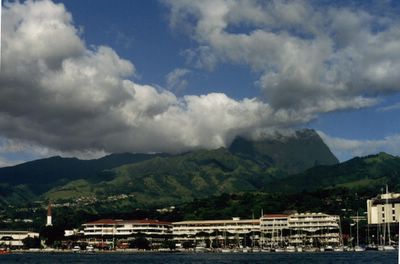 Trade Wind Clouds, Papeete Trade Wind Clouds, PapeeteAnchored in Noumea Harbor the mountains behind the town reminded us we were in the Pacific. We've seen mountains like this on countless Pacific islands from Tahiti to Taveuni, from Samoa to New Caledonia. As the trade winds blow over the mountains of New Caledonia the clouds leave their shadows on the green, rain eroded sides. Maybe this is the archetypical Pacific scene, a blue shaded, wind swept harbor, anchored yachts with flags of every nation whipping at the gaff, a town with red roofs and radio towers, and behind them, the mist shrouded mountain with colors dulled by the dark moisture filled trade wind clouds. We watch the weather and the time goes by and we look at the charts for the best route to the next port, wondering when we will feel like pulling up the hook and facing those trade winds blowing solidly just outside the harbor's gates. Baie Moselle, in New Caledonia, is a French place, but it has that South Pacific feel with locals fishing and laughing on the quay. These locals, Melanesians, they always wave friendly like, as we pass them, motoring into town in the dingy for fresh bread and whatever other provisions we think we can afford, French prices are high. We wonder if the locals fishing on the pier ever catch anything. They're part of the scenery to us, just part of another town in the tropics, to us, one of so many, hot and quiet and dusty in the streets when we have to carry our bags back to the dingy, and cool out in the bay, where the waves splash us and the wind never seems to lessen. In the morning we turn on the radio and tune in on each pre-planned sked, or radio schedule. At 8:00 it's the vessel Ulu, and at 17:30 at night it's Kokomo. Through the static a voice comes in, "Where are you?" "Baie de Prony, and you?" "Still Port Moselle, but we might leave Sunday. What's it like in Prony?" " Nice, but the winds hasn't stopped, we think we'll go to Ouvea tomorrow or the day after, but we're waiting for a west wind." So is half the fleet, we think, ourselves included. " Well, if we get out that way we'll see you. Have a good sail if we don't see you." Tenuous contact, at best, but you hang onto that contact, the radio is your life line, over the wind driven cloud enshrouded mountains of the Pacific islands, these lonely outposts where the cruisers hang out. This afternoon we went out in the dingy. We visited Astor and traded books, so we'd have a new supply to read on the next passage, or in the next hurricane hole where we might be waiting out the weather. Then we stopped at Egress II, and renewed an old acquaintance, but we didn't stay, and then we got some weather information from John on Ostrica, which weather fax stations he prefers and where he gets his local weather, preferably not in French. "From John on Norfolk Island" he says. We chat for a while about tides in Havannah Pass until his dinner guests arrive. And then we went back to Wings for our own supper, a pasta dish, and we drank some red wine and filled up on fresh French bread. If we head out on Sunday we'll take as much French bread as we can eat before it gets stale, and then maybe we'll find another town in another harbor underneath another Pacific island cloud swept mountain where the locals wave from the pier and the store has French bread, if you get there before noon. We motored several miles up a long channel into the mountains of New Caledonia, not a fiord, but into the mountains nevertheless, and we anchored in a very quiet place with the name Carenage. In the Carenage the hills surrounded us and the water was still. We wondered what it was like outside, back in the open reaches of the lagoon, but that was idle curiosity, since up here, that didn't matter, it was a different world. Anchored nearby was a French boat, a ketch, steel, from the looks of the chines, with one tan mast and one white, which was slightly strange, but so are many French boats. Behind her was a Kiwi vessel, you can tell them by their shapes too, with a distinctive sheer and a house which stepped higher as it went aft. We saw the flag, red with the union jack and the Southern Cross, which confirmed the New Zeeland registry. We motored over in the dingy. A smell of fresh paint reached our noses as we fell in behind her stern, and a bare chested man greeted us, "Guday". Sounded Aussie but the flag said otherwise. Geoff introduced himself, and we reciprocated with the name of our vessel and our own. His partner poked her head out the hatch, "That's Chris." He said, "I've been doing a bit of maintenance". "I could smell the paint," I said. "We've been smelling it for a week" was his answer. "How long have you been up here?" "About ten days." Chris nodded agreement. Geoff and Chris told us a little about their boat, Wakaya, which is a classic, wooden, New Zealand boat over 50 years old, and they've had it for 20, and they invited us aboard for a tour. After admiring their Kauri wood and Mahagony, and seeing the other beautiful timber work, and being amused at the quaint 50 year old houshold electric switches we thanked them for the coffee and cake and then we asked them about the local sights. They told us where the trails were around the bay and we thanked them, and we motored off. We went up a couple of river mouths in the dingy, one to a creek with some small waterfalls and pools, and a place to tie up the dingy. We followed a trail up the hill and then onto an old road that led around the bay. We found a place were we could look out over the bay and see Wings anchored below. We went back to the waterfalls and stripped down and bathed in the cool fresh water, conserving ship's water that showers onboard would have otherwise required. Then we motored up the other river, this one slightly bigger, with mangroves and a lazy current, until we came to some rapids. We stopped the motor and let the current take us back down stream, listening to the birds on shore as we drifted. Later we sat in the cockpit, drinking rum and fruit juice with ice, a luxury on Wings, since the refrigerator we had for years wouldn't make ice, but the new one will, so we savored it. We watched the water reflect the last light of the day, and enjoyed the stillness of a quiet anchorage far into the mountains. When we had looked at the mountains behind Noumea harbor we knew that was a typical Pacific island view, but this scene was just the opposite, not typical of the Pacific at all, more reminiscent of an anchorage in British Columbia or Alaska than the South Pacific. After a couple of days working on boat projects and taking various short hikes to waterfalls around the Carenage, we left this beautiful anchorage and sailed out of the New Caledonia lagoon through Havannah Pass and overnight to the Loyalty Islands. The Loyalties, part of New Caledonia but separated from the it by 60 miles of ocean, are less populated, less developed, and less European than the mainland of New Caledonia. Mick and Chris on Ulu told us to expect to feel like we were back in the tropical Pacific islands. Sounded good, so off we went. This trip called for an overnight passage to get the timing right at the pass and to arrive at the destination in daylight. This meant sailing slowly all night, otherwise we'd get there at 2:00 am. We didn't use the jib and we had the main reefed, deeply, and even overtrimmed to reduce the sail's efficiency. We still arrived at Mare Island in the Loyalties before daylight and we wound up reaching back and forth in the offing waiting for enough light to get into the anchorage. The night sail was OK though, easy enough, but still, we would rather be in a snug anchorage and sound asleep in our bunks than sailing all night. Does this feel like the Pacific? In a different way from the mountians behind Noumea, yes. It looks like Nuku' alofa in Tonga, flat and green and small collections of houses in the follage ashore. So this is another side of the Pacific, the low islands. The water is clear and there are coral patches in the sand all over our anchorage. The water is so clear, in fact, that we were dodging coral heads coming in here which we later figured out were down 60 feet, but it looked like 15 feet. Then we had to find a patch of sand to anchor in, and we evidently missed because right now the anchor chain is dragging across a rock patch and making a racket. Maybe we'll move. On the beach is a Burre, one of the open walled, thatched roof, family meeting houses which we last saw in Samoa, and there is a market day in one of the neighboring villages. The market only goes until 11:00 though, and we don't have time to get there. Maybe Mick and Chris will bring us a loaf of bread. Now that is pretty much what cruising in the Pacific is all about. Fred & Judy, S/V Wings, Loyalty Islands Click here for more photos from New Caledonia Labels: Loyalties, New Caledonia
Nov. 14, 2000-Tradewinds to Australia
wingssail images-fredrick roswold

Wings in New Cal
It took us two tries to make it out of New Caledonia.
After the wind-up of the Pacific Arts Festival the 300 cruising boats in Port Moselle started looking at departure dates for leaving New Caledonia. For most, including Wings, the next destination was going to be Australia, and, as the season was advancing, we were all itching to go. Boat projects were hurried along, provisions taken aboard and the weather was checked and checked again.
Even then many of us got it wrong.
The winds had been westerly and we needed SE for an easy passage to Australia. On Wednesday, November 8, the wind was still westerly but with a decent but not definitive weather forecast for SE winds the next day, the herd mentality took over as crews around the harbor who heard that others were keen to go in the morning decided that it was time for themselves as well. A rush of boats, Wings among them, departed Thursday morning and many were soon heading east across the lagoon for Passe Dumbea. Before long this fleet encountered strong westerly winds, squalls, and heavy rain instead of the Southeast Trades which were hoped for. It seemed that a pesky low had developed overnight just southeast of Noumea and we were getting the clockwise wind on the back side of it. In the hurry to get underway that morning few had looked carefully at the new weather information we had available and now we were paying the price for this haste. Motoring towards the pass boats were bucking and slamming into a sharp chop with rain and wind whistling through the rigging. The ocean outside the pass looked rough.
We turned back before reaching the pass. It was one of the rare times when we’ve turned back in the face of bad weather and it was a tough decision, particularly since Sandy & Lloyd Banta, on Warrior, with whom we had an informal race to Australia, were going on, but we didn’t see the point of heading out to beat ourselves up in rough conditions and contrary winds. That night, back in port, we felt good about our decision as we listened on the SSB radio to the boats which had carried on complain about their wind conditions. Meanwhile the weather office confidently stated that Friday morning the wind would finally go SE. We prepared to get underway again Friday, never mind the old superstition about the bad luck of leaving on a Friday.
So, on Friday we set out again and this time we had favorable winds. With a good heading and a number 4 jib we were soon reaching to the SW. Saturday and Sunday passed with steady breeze and we made good speed. By Monday we started thinking that this was probably going to be one fast trip; we continued to experience ideal conditions with southeast trade winds at 15 to 25, reasonably smooth seas and clear sunny skies. It was beautiful sailing and we were going like crazy on a beam reach with a full main and #4 headsail, doing over 7.0 knots continuously. We logged a noon to noon run of over 170 miles, a very nice distance for us, and by Tuesday we’d averaged 7.75 for a couple of days, making a run of 187 miles. Our destination was Bundaberg, Australia but we jibed and headed a little north of the rhumb line and we found better wind than the other boats traveling the same route more to the south. We were optimistic about our chance of beating Warrior’s time. The next day we logged 186 miles.
Besides being fast, this passage was easy, not too windy or rough, few sail changes, few squalls or rain, just lots of rest and reading, and a full moon at night to make the night watches easier.
This is how passage making ought to be.
We finished off the trip with one squally night as we approached the Australian coast. Surfing in south of the Great Barrier Reef we reduced sail to arrive at Bundaberg at dawn. In four days and 21.5 hours we covered the 800 mile distance that had been estimated by the majority of the cruising fleet as being a five to eight day passage. We wondered how Warrior had done.
While we enjoyed the sail we were also happy to be in Australia. Australia! We'd arrived in the land of Ayers Rock and Alice Springs, of 'Roos and Wallabies, and Dancin' Matilda. This is an exciting landfall for us and we can hardly wait to get ashore and look around.
Fred & Judy, SV Wings, Bundaberg, Australia
Click here to see more photos.
Click here to see the hardcopy log of the trip Labels: Australia, Bundaberg, New Caledonia, Port Moselle, sailing
November 8, 2000-Pacific Arts Festival
 Pacific Islander Pacific IslanderWe have just completed a fantastic two weeks watching the Pacific Arts Festival in Noumea, New Caledonia, and this event was outstanding. If you have a chance to see it yourself, either by visiting one of the countries hosting it sometime in the future, or seeing it on TV, do yourself a favor and add it to your schedule. It is great. We are wondering if we can make the next one in Palau in 2004? It was hard for me to imagine wanting to watch native dancing every single day for 12 days in a row. I mean, just how much dancing can you see before you feel that you've seen it all and start getting tired of it? If you'd have asked me about a month ago I'd have said that I could take about 1/2 hour, max. Well, let me tell you that this year I watched native dancing and other acts for a couple of hours a day for nearly two weeks along with thousands of local and visiting audiences, as well as several hundred other cruisers, and none of us, myself included, seemed to get enough. The dancing, singing and music were just that varied and just that good.  Pacific Arts Festival Pacific Arts FestivalTwenty three Pacific Island countries, covering the area from Easter Island to Guam, Hawaii to Australia, sent delegations to Noumea for this festival, and invariably these groups, which included artisians, administrators, and politicians as well as the performers and their support people and equipment, were hardworking and talented entertainers who put on two or three shows per day, generally under a blazing sun, day after day, and right up to the last show on the stage the night of the closing ceremony they displayed energy and enthusiasm as well as grace and beauty. We were enthralled. We also don't know know how they did it. The dances were highly physical, the venues were blisteringly hot, and it must have been exhausting. Then there were the mundane things like accommodations, (hotel rooms ran out and some of the Tahitians, for example, were lodged in native huts on the grounds of the museum at the Cultural Center), meals, and the logistics of the performances. Just the laundry issues must have been daunting. One night I stumbled into the dorm where the Fijian dancers were housed and it was a jumble of clotheslines and ironing boards as the dancers themselves prepared their costumes for the next day. Click HERE to see all the pictures. While there were wide variances in the dance styles and music, as well as in the dress and racial characteristics of the peoples themselves, there is a common musical and dance thread throughout the Pacific and the pounding, frenetic, rythmic, native drums were pervasive. We couldn't keep our feet from tapping. In addition to the music and dancing there were art exhibits, fashion shows, plays and films, and demonstrations of craftwork and native cooking. All of this was spread out over about ten venues throughout the city. Each day we reviewed the schedule, made out our own agendas, and tried to figure out how we would arrange our transportation. We walked, bussed, taxied and dingyed all over the Noumea area. As wonderful as the formal festival was, an equally neat aspect for me was unscheduled and unorganized. I loved being surrounded by the multicultural crowds. This festival is really a gathering of Pacific peoples and throughout the city, on every festival ground, in every park, bus, restaurant, and hotel lobby, there were families, small groups or crowds of people here from all over the Pacific. They wore their own colorful clothing and displayed a wide variety of physical characteristics from the small Asian people from Guam to the huge Polynesians from Tonga and Samoa, from the dark Melanesian Aboriginies from Australia to the light skinned and fine boned Easter Islanders. We saw every shade of brown skin, every shape of nose, and all kinds of hair, all of it surrounding smiling, happy faces of holidaying families. The little kids were everywhere too, with wide open bright eyes filled with wonder and enthusiasm. If we were watching the dancing with interest and enjoyment, the little kids were captivated by it. They crowded to the front and sat google eyed from start to finish. I didn't even mind getting poked and prodded by tiny elbows and feet on kids totally oblivious to their surroundings, just because it was so much fun to share their excitement. Festival aside, we have also been enjoying the city of Noumea. It is an interesting mix of modern and late 1800's layout, with a French, native Kanak, and oriental population. Facilites and services available are great, if expensive, and the harbor offers good protection. On the downside, there is a horrible pollution problem which finally forced us out of the marina. Noumea seems wealthy but they have chosen to continue to dump raw sewage into the inner harbor which not only being unhealthy, spoils the natual beauty of this nice setting, and stinks to high heaven. Even walking in town the smell and sight of sewage running in the gutters was appalling. Oil is also present in the harbor in quantity, and we spent hours scrubbing filth and gummy black deposits off of our waterline. We were also dissapointed in the transportation system here, buses stop at 6:30 and taxis are nowhere to be found; if you call one you pay a high surcharge for their trouble of comming to pick you up. Of course the people who run this country don't mind, they are all driving their own high priced French or German luxury automobiles. The thoroughly subjugated native Kanaks simply walk or stay home. A minor inconvienience with a humorous aspect was the curioius habit of Noumeans of serving and drinking their red French wines chilled nearly to ice. When we ate out it was a struggle to get a good, unchilled, wine (oh what hardships we cruisers must suffer!). So now we look towards Australia. Wings, along with a few hundred other cruising boats, is getting ready to head out. We closely watch the weather, cyclone season is approaching, and try to time our departures for a fast safe passage. We have our boat ready, we need only a few provisions and a load of duty free fuel, then we will set sail for the 5 to 8 day passage to Bundaberg, on Australian's sunny Queensland coast. We'll write about that passage after we arrive, but don't worry if you don't hear from us for a while, we might not even leave for a week or more, depending on the weather. In the meanwhile, we'll continue to search for a good, unchilled, red wine. Fred & Judy, S/V Wings, Noumea, New Caledonia  Pacific Arts Festival Pacific Arts FestivalLabels: New Caledonia
November 1, 2000-Weekend Fun in New Caledonia
 Windsurfer Boy Windsurfer BoyOn the weekends the French residents of New Caledonia hit the water. This is a boater's paradise and the French upper class enjoy it to the max. Saturday we sailed WINGS to Baie Maa, just 10 miles north of Noumea. When we rounded the corner to enter the bay we saw 20 sailboats anchored and another 10 or so power yachts. Then as afternoon wore on the smaller boats showed up; at least a couple of dozen 20-30 footers with several towing water skiers. Baie Maa was nice but it seemed too crowded for us. Finally at 1:30 we upped anchor and motored another 10 miles over to Baie Papaye. There were a number of boats there too, but it was too late in the day for us to move further. Anyhow, we know what happens on Sunday afternoon: before sundown the locals head home. One by one the powerboats and local sailboats upped their anchors and headed south to Noumea. By sunset there were a few boats left, cruising yachts mostly, and the bay was peaceful. A couple of dolphins cruised through and we sat in the cockpit watching them and enjoying the silence. On the hill above us we spotted a small herd of horses waiting at a gate to be let back to the barn. We listened to Neil Young on the outside speakers until it was dark, then a little longer. The first time I was aboard WINGS at night was motoring through the Lake Union Ship Canal in June 1986. It was after work one night and we were moving WINGS from Lake Union through the locks to Shilshole Bay Marina, which would be our home for ten years once we moved aboard WINGS later that month. As we motored along I remember a thrill I had looking down from the deck into the cabin and seeing Judy moving around the galley in the light of the fixture on the forward bulkhead while I steered from the deck above. It thrilled me because it was ours and because it was a real ship. I stood on deck, in the darkness, near the main hatch, with the tiller extension in my hand, steering through the night, and while Judy, bathed in light, worked below. WINGS was a whole world which moved steadily through the darkness. My view that night was lights and bridge tenders and watching for kayaker's silhouettes in the city's lights reflected on the canal's rippled waters. Judy's world was light and cabin and the steady thrum of the engine. Together on that night, we were a team on our way to tomorrow. Now, 14 years later, as I stand on that same deck in a small bay outside of Noumea, Caledonia, 6000 miles away from Seattle, and 14 years later, not much has changed. Tonight we are not underway, we are anchored in Baie Papaye, in New Caledonia in the South Pacific, listening instead of the engine to Neil Young's mournful song on the outside speakers, But it is still WINGS and it is still Fred & Judy, it is still the same broad flat deck, the same unobstructed view forward, and below, even the same bulkhead light. Judy moves around with the same confidence that we are OK that she did those 14 years ago in the Lake Union Ship Canal. This is our life, and I feel so fortunate to have found it on that night all those years ago in Seattle...and to have it still now. On Tuesday we motored out across the lagoon to a small desert island. Just a sand dune really with a few bushes on it. We thought it would be fun for some swimming and to play on the beach. Of course it rained and the wind blew from the wrong direction and we had to set our GPS on anchor watch that night in case the anchor didn't hold, which it did, but it was still an uncomfortable evening. Then the next day we noticed that we had a school of large Remoras under the boat. We lured them out with some left over couscous and counted about a dozen, each about three feet long. They are probably harmless but they look like sharks, and besides, don't they normally hang around with sharks? Nearby some other fish were making a fuss and thrashing up the water but we couldn't see what they were. Judy said she was ready to leave this place at any time, and she wasn't going swimming here. We moved on.  Baie de Vincent Baie de VincentOn Wednesday we reached Baie St. Vincent, on the Southwest coast of New Caledonia. On Thursday we moved towards its desolate inner reaches, a huge, empty, yet beautiful bay of innumerable islands, small coves, and barren rounded hills. Much of Baie St. Vincent is shallow so you can't get too far into it. The whole area is surrounded by mountains. In this bay the silence and size of its emptiness overwhelmed us. Through 360 degrees we were surrounded by an unpopulated void. On the beach of the small island behind which we sought shelter from the persistent wind was a house, or more precisely, a corrugated iron lean to. However, it was unoccupied and for now at least, abandoned. In the far distance, beyond the edges of this bay, we saw in the surrounding mountains the occasional small speck which was a building, and among the lower hills, a row of transmission towers. But still, the distance which separated us from those signs of civilization, five to ten miles at least, made us feel alone. As night fell we played mournful eerie music on the stereo because it fit the surroundings, and we sat outside and watched the bay fall into empty darkness. A quiet mood fell over us. When it became black on the edges of our world, some of the distant specks turned into lights winking at us, and we knew that we were not really alone. To the southeast the clouds reflected a vague light, which we knew was Noumea, so we were not so far away after all...here in the back of the vast South Pacific ocean, alone was still a relative concept. Friday morning I got up before Judy, when daylight awakend me, and made coffee. Then I went on deck and coiled a few lines. Later we motored around the bay and explored it in detail, then sailed back to the desert island called Mbe Kouen to meet Ed & Julie on CINNABAR. Saturday we had a wonderful sail upwind in 20-22 knots, blue sky and blue seas, tacking behind the points to stay in flat water and get the lifts coming out. We made good time on some other boats going the same direction. It felt great. Now we are back in Noumea for the Pacific Arts Festival. We'll write to you to tell you how it was. Click here for another photo Click here for another one. Fred & Judy SV Wings, New Caledonia Labels: New Caledonia
October 23, 2000-Noumea, New Caledonia
 Noumea NoumeaNew Caledonia 10/18 Another month, another country. We arrived in Noumea, New Caledonia at 2:00 PM Tuesday, after a fast, if wet, 50 hour trip from Port Vila, Vanuatu. If our complaint about a "wet" passage is getting familiar to you, it is getting old to us. Once again we were getting splashed by big waves for far longer than we wanted and once again, too much of it got below and dripped all over everything. No permanent damage but we got some books soaked and a lot of laundry to do. So we have another "anti leak" campaign planned. Noumea, totally French, is pretty big and absolutely modern and civilized. This is the biggest and most normal city we have seen in the Pacific outside of New Zealand. It looks like some kind of French flavored Southern California beach town, but big. And everything looks new. We've just got here and haven't yet had time to check it out much, but we will. So we just wanted to let you know that we arrived safely, and we'll write more later. New Caledonia 10/23 WINGS is tied securely to the dock in Noumea where we are enjoying the Pacific Arts Festival. A few thousand Pacific islanders from 23 island countries have come here to dance, sing, and display various native arts and crafts. A few hundred cruising yachts from all over the world have come here to flock in herds to the various festival venues, drink too much French wine, and spend too much money, but we love it! We will write more later. Fred & Judy, S/V Wings, Noumea Labels: New Caledonia
NEXT Page (More)
|


.jpg)

